
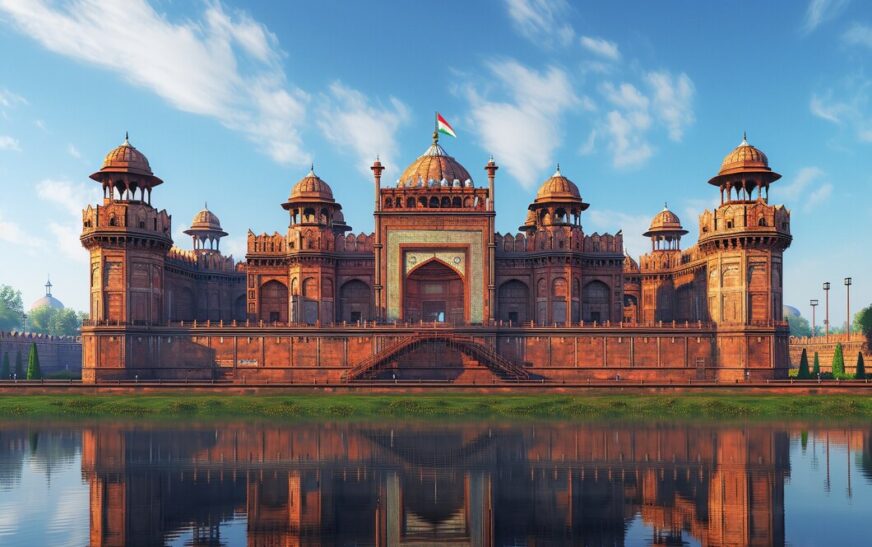
![India Unboxed: 10 Places That Will Shatter Your Expectations [Updated-2025]](https://traveloinfo.com/wp-content/uploads/2025/10/a10-872x547.jpg)
India Unboxed: 10 Places That Will Shatter Your Expectations
Let’s be honest—when you picture India, certain images immediately spring to mind: the majestic Taj Mahal, the sacred Ganges River, the colorful chaos of Delhi. But what if we told you that these iconic images represent just one layer of a country with more diversity than all of Europe? What if the real India is hiding in plain sight, waiting to shatter every expectation you ever had?
Welcome to India Unboxed—a journey beyond the postcards and into a land that constantly defies categorization. From Arctic-like landscapes to villages where women rule, here are 10 places that will completely redefine what you think you know about India.
1. The Cold Desert: Ladakh’s Martian Landscape
Expectation: India is all tropical heat and humid coastlines.
Reality: A high-altitude desert that feels like another planet.
While everyone pictures palm trees and beaches, Ladakh sits at 11,500 feet in the Himalayas, where the air is thin and the landscape is straight out of a sci-fi movie. This is India’s only cold desert, where Buddhist prayer flags flutter against a backdrop of stark, brown mountains and turquoise lakes.
What Will Shatter Your Expectations:
-
Pangong Tso Lake: A 25-mile-long saltwater lake that changes color from azure to turquoise to emerald throughout the day
-
Nubra Valley: Where double-humped Bactrian camels roam sand dunes against a backdrop of snow-capped peaks
-
Culture: Predominantly Tibetan Buddhist, with ancient monasteries perched precariously on cliff faces
Best Time to Visit: May to September, when the high mountain passes are open
2. The Living Root Bridges: Meghalaya’s Botanical Marvels
Expectation: India’s architecture is all temples and palaces.
Reality: Bridges that grow stronger with time.
In the remote Khasi hills of Meghalaya, nature and human ingenuity have collaborated for centuries. The Khasis have trained the roots of rubber trees to grow across rivers, creating living bridges that can support dozens of people and become stronger over generations.
What Will Shatter Your Expectations:
-
Double Decker Root Bridge: A two-level bridge that looks like something from a fantasy novel
-
The Journey: Reaching these bridges involves hiking through some of India’s wettest rainforests
-
Sustainability Lesson: These bridges represent an ancient form of eco-engineering that modern architects are only beginning to understand
Best Time to Visit: October to April, avoiding the heavy monsoon rains
3. The White Desert: Kutch’s Salt Marsh
Expectation: India is perpetually crowded.
Reality: A vast, empty landscape where you can hear your own heartbeat.
The Great Rann of Kutch transforms into an otherworldly white desert during the dry season. This massive salt marsh stretches to the horizon, creating optical illusions and a sense of infinite space that feels completely alien to the India of crowded cities.
What Will Shatter Your Expectations:
-
The Rann Utsav: A cultural festival held on the salt flats under the full moon
-
Stargazing: Some of the clearest night skies in India, unpolluted by city lights
-
Wildlife: Home to the last population of Indian wild ass and flamingo colonies
Best Time to Visit: November to February, during the Rann Utsav festival
4. The Matriarchal Society: Meghalaya’s Khasi Hills
Expectation: India is a patriarchal society.
Reality: A place where women inherit property and children take their mother’s surname.
In the Khasi tribe of Meghalaya, the traditional gender roles are reversed. The youngest daughter inherits the family property, men move into their wife’s homes after marriage, and the family lineage is traced through the mother’s side.
What Will Shatter Your Expectations:
-
Women-Led Economy: Women control most businesses and property
-
Cultural Balance: Despite the matriarchal system, there’s remarkable gender harmony
-
Modern Challenges: How this ancient system is adapting to globalization and modern pressures
Best Time to Visit: October to May, when the weather is most pleasant
5. The French Quarter: Puducherry’s European Enclave
Expectation: India was only colonized by the British.
Reality: A slice of the French Riviera in South India.
Puducherry (formerly Pondicherry) feels like someone airlifted a Mediterranean town and dropped it on the Coromandel Coast. With its yellow colonial buildings, French cuisine, and grid-patterned streets, this former French colony maintains a distinctly European flavor.
What Will Shatter Your Expectations:
-
Auroville: An experimental international township dedicated to human unity
-
French Bakeries: Croissants and baguettes that rival Paris’s best
-
The Promenade: Evening walks along the seafront that feel more Mediterranean than Indian
Best Time to Visit: October to March, when the coastal weather is perfect
6. The Fossil Park: Himachal’s Prehistoric Treasure
Expectation: India’s history begins with ancient civilizations.
Reality: A 1.5-million-year-old fossil bed that predates human history.
In the Shivalik Hills of Himachal Pradesh, the Suketi Fossil Park contains perfectly preserved skeletons of prehistoric animals that roamed the area millions of years before humans arrived. This is where scientists discovered the Sivapithecus, a crucial link in primate evolution.
What Will Shatter Your Expectations:
-
Life-Size Reconstructions: Massive models of the animals that once lived here
-
Museum: A fascinating collection of actual fossils and geological exhibits
-
Context: Understanding India’s place in the prehistoric world
Best Time to Visit: March to June and September to November
7. The Floating Islands: Loktak Lake, Manipur
Expectation: Indian lakes are conventional bodies of water.
Reality: A lake where the islands move and people live on them.
Loktak Lake is the world’s only floating national park, with phumdis—massive, floating islands made of vegetation, soil, and organic matter. The local people have built entire fishing communities on these drifting islands.
What Will Shatter Your Expectations:
-
Keibul Lamjao National Park: The world’s only floating wildlife sanctuary
-
Sangai Deer: The endangered dancing deer found only here
-
Fishing Culture: Unique techniques developed for this unusual environment
Best Time to Visit: October to April, when the weather is dry and pleasant
8. The Coral Churches: Andaman’s Colonial Legacy
Expectation: India’s religious architecture means temples, mosques, and gurudwaras.
Reality: Churches built from coral and seashells.
On the remote Andaman Islands, colonial-era churches were constructed using an unexpected local material: coral. These structures have withstood tsunamis and tropical storms, their unique construction method preserving a piece of history against all odds.
What Will Shatter Your Expectations:
-
Construction Technique: How coral and seashells were used as building materials
-
Historical Context: The islands’ history as a British penal colony
-
Resilience: How these structures have survived natural disasters
Best Time to Visit: December to March, when the seas are calm
9. The River Island: Majuli, Assam
Expectation: Islands are found in the ocean.
Reality: The world’s largest river island, slowly disappearing.
Majuli, in the Brahmaputra River, is a cultural and ecological wonder that’s vanishing due to erosion. This massive river island is home to unique Vaishnavite monasteries and a way of life that’s literally washing away.
What Will Shatter Your Expectations:
-
Satras: Ancient Vaishnavite monasteries preserving unique art forms
-
Erosion Crisis: Watching an entire culture adapt to their disappearing homeland
-
Birdlife: Some of India’s best birdwatching, with migratory species from as far as Siberia
Best Time to Visit: October to March, when the weather is dry and cool
10. The Silicon Valley of the East: Bangalore’s Tech Revolution
Expectation: India is trapped in the past.
Reality: A city shaping the future of global technology.
Bangalore represents an India that many visitors never see—a bustling, modern metropolis where startup culture thrives and the streets are lined with tech parks rather than ancient monuments. This is where India’s brainpower is building the future.
What Will Shatter Your Expectations:
-
Startup Ecosystem: Second only to Silicon Valley in startup activity
-
Cosmopolitan Culture: A young, educated population creating a new Indian identity
-
Contrasts: Ancient temples next to gleaming tech campuses
Best Time to Visit: Year-round, though the weather is best from October to February
Planning Your Reality-Shifting Journey
When to Go: India’s diversity means there’s always somewhere with perfect weather. Generally, October to March offers the best conditions across most regions.
Getting Around:
-
Domestic flights connect major cities
-
Trains offer an authentic experience (book AC classes for comfort)
-
Private drivers are affordable for regional travel
Cultural Preparation:
-
Pack for multiple climates if visiting different regions
-
Learn a few Hindi phrases
-
Be prepared for sensory overload and incredible hospitality
Mindset Shift: The most important thing to pack is flexibility. India will challenge your assumptions daily—embrace the discomfort that leads to growth.
The Real India Awaits
The true magic of India lies not in confirming your expectations, but in shattering them. It’s in discovering that a single country can contain Arctic-like deserts and tropical beaches, ancient traditions and cutting-edge innovation, crowded cities and vast empty spaces.
These 10 places are just the beginning. Every corner of India holds surprises waiting to challenge what you think you know. The country’s greatest gift to travelers isn’t the sights you came to see, but the perspectives you never expected to find.
So come with an open mind and a willingness to be proven wrong. Let India unbox itself for you, revealing layers you never knew existed. The journey will change not just how you see India—but how you see the world.
![Shiv Temple, Ghansoli, Navi Mumbai [Updated-2026]](https://traveloinfo.com/wp-content/uploads/2026/07/nerul.jpg)
![Hanuman Temple, Kharghar [Updated-2026]](https://traveloinfo.com/wp-content/uploads/2026/07/HANUMAN.jpg)
![Bangalore, Karnataka City Guide: Where To Go, Stay, Eat, And shop in India’s best city. [Updated-2025]](https://traveloinfo.com/wp-content/uploads/2025/02/bangaloref.jpg)
![Hyderabad, Telangana City Guide: Where To Go, Stay, Eat, And shop in India’s best city. [Updated-2025]](https://traveloinfo.com/wp-content/uploads/2025/02/hydrabad1.jpg)
![Ahmedabad, Gujarat City Guide: Where To Go, Stay, Eat, And shop in India’s best city. [Updated-2025]](https://traveloinfo.com/wp-content/uploads/2025/02/ahemadabad1.jpg)